What aircon servicing costs in Singapore and what changes the price
By Sam Lee · Updated 2026-05-12
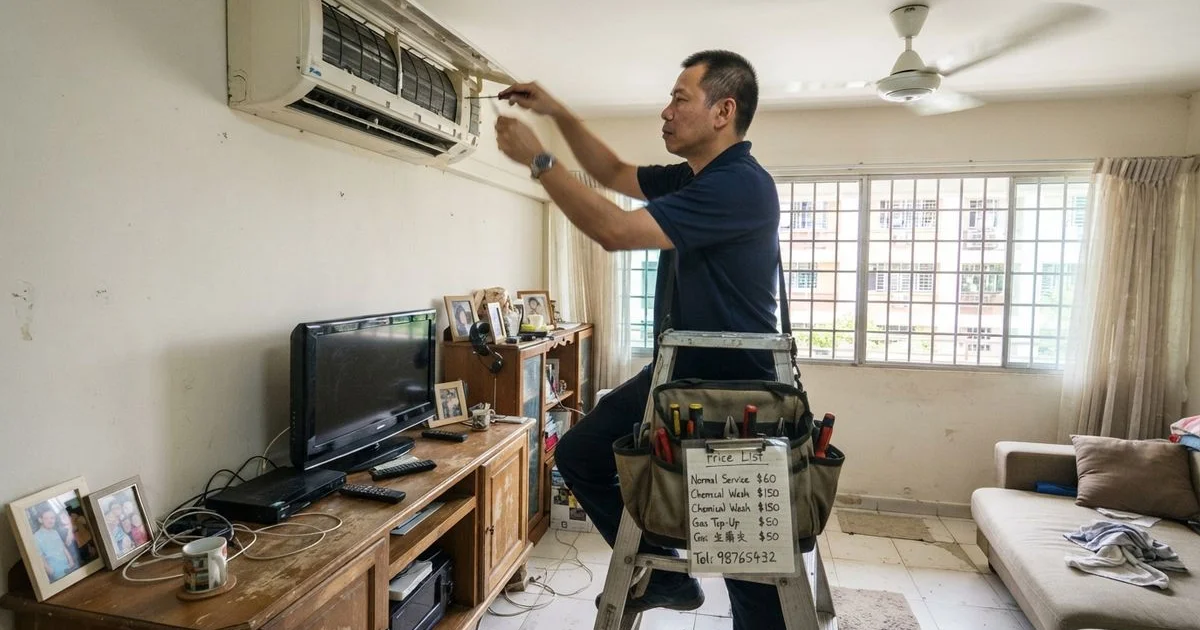
Aircon servicing is one of those costs that never has one clean answer, because the price depends on how many units you own, how hard they work, and what “service” actually means to the contractor you call. Here’s how to read a quote before you agree to it.
What a standard service actually covers
A routine service visit is general maintenance, not deep repair. A technician typically opens the indoor unit, cleans the filter and coil, checks the drainage, and confirms the unit is cooling properly. It is not a chemical wash and it does not include topping up refrigerant gas if the unit is low, both of those get quoted as separate jobs once the technician spots a problem.
Where this catches homeowners out: two quotes that look identical on paper can cover different work. Always ask what’s included before comparing price against price.
What actually changes the price
Four things move the number more than anything else:
- Number of units. Each additional unit adds to the bill, though the rate per unit usually drops once you’re booking several at a time.
- How often the unit runs. A unit used occasionally, a few hours a week, tends to need less work per visit than one running near-constantly in a server room or an infant’s room.
- How many visits a year. Most homes do fine on three to four visits a year. Fewer visits mean each one may need to work harder to catch up.
- Access. A unit mounted high on an exterior wall or behind furniture takes longer to reach, and that time gets billed.
| Factor | Typical effect on price |
|---|---|
| Extra units in one visit | Lower cost per unit, higher total |
| Light, occasional use | Lower end of the range |
| Near-constant use | Higher end, sometimes a premium |
| Difficult access (high wall, tight space) | Added labour charge |
| Chemical wash or gas top-up | Billed as a separate line item |
Gas top-up and chemical wash: read the quote carefully
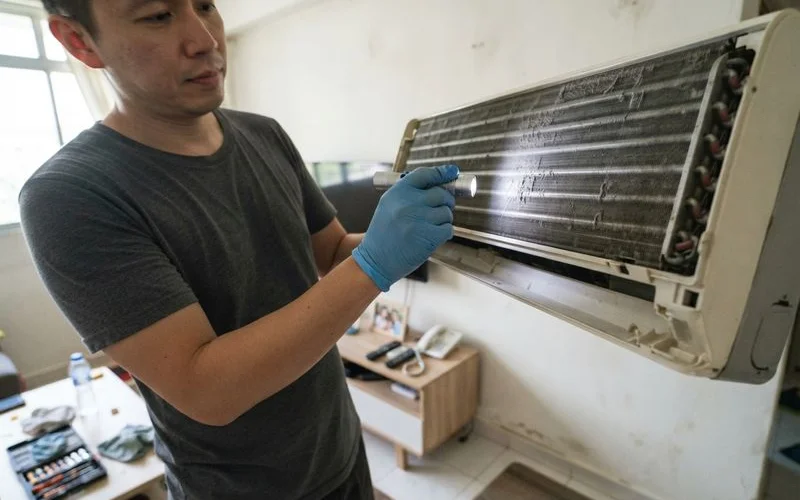
If your unit isn’t cooling as well as it used to, the fix usually isn’t a routine service, it’s either a chemical wash to clear built-up dirt or a gas top-up if there’s a slow leak. Both cost more than a standard visit because they take longer and use more materials. A technician who tells you which one you actually need, rather than upselling both by default, is worth keeping on your list.
Contract or one-off: a quick note on value
Booking a maintenance contract for three or four visits a year usually costs less per visit than calling a different contractor each time, and it means someone is tracking your service history. It only pays off if you’d genuinely book that many visits anyway, paying for a five-visit contract when your unit needs three isn’t a saving.
A realistic range to expect
For a typical home running two to three units on a daily basis, three to four visits a year, budget for a modest annual servicing spend that scales with unit count and usage rather than one fixed number. Read every quote against what it actually covers, not just the total at the bottom, and don’t assume the lowest number is the best deal until you know what’s excluded.
How to compare two quotes fairly
The easiest mistake when comparing quotes is looking only at the bottom-line figure. One contractor’s number might include a filter rinse and a quick visual check, while another’s covers the same price but adds a proper drainage flush and a function test under load. Ask each contractor to list what’s included per unit, whether the price changes for hard-to-reach units, and whether gas top-up or chemical wash would be quoted separately if the technician finds a problem. A slightly higher quote that’s specific about scope is often a better deal than a vague, cheaper one.
It also helps to ask how the contractor prices repeat customers. Some offer a modest discount for homeowners who book on a regular schedule rather than calling only when something feels off, since a well-maintained unit is generally quicker to service than one that’s been neglected for a year or more.
Why the cheapest quote isn’t always the smart choice
A quote well below everyone else’s isn’t automatically a bargain. It can mean a shorter visit with less actually done, a technician working through jobs too quickly to catch early problems, or a follow-up “discovery” of extra work once they’re already inside the unit. None of this means the cheapest option is always wrong, but it’s worth asking the same scope questions of a low quote that you’d ask of a mid-range one, rather than assuming price alone tells you what you’re getting.
For a fuller sense of the contractors covering this work, our aircon servicing and maintenance hub lists options across the area, and our scoring method explains how we weigh pricing feedback alongside everything else. You can also browse the full directory for related services.
FAQ
- How much does a routine aircon service cost in Singapore?
- A standard service visit for one unit usually falls in the S$30 to S$50 range, with the total scaling by how many units you have and how often the unit runs. Gas top-ups and chemical washes are priced separately.
- Is a chemical wash included in a normal service?
- Not usually. A routine service is a general clean and check. A chemical wash is a deeper strip-down clean and is quoted as its own job, typically needed once every year or two depending on usage.
- Does servicing more units at once bring the per-unit price down?
- Often, yes. Many contractors offer a lower rate per unit once you're booking three or more in the same visit, since the callout cost is shared across the job.
- How do I know if a quote is too cheap to be legitimate?
- A price well below the rest of the quotes you've collected is a reason to ask more questions, not less. Confirm what's actually included, whether gas top-up is bundled in, and whether the technician is trained on your unit's brand.